
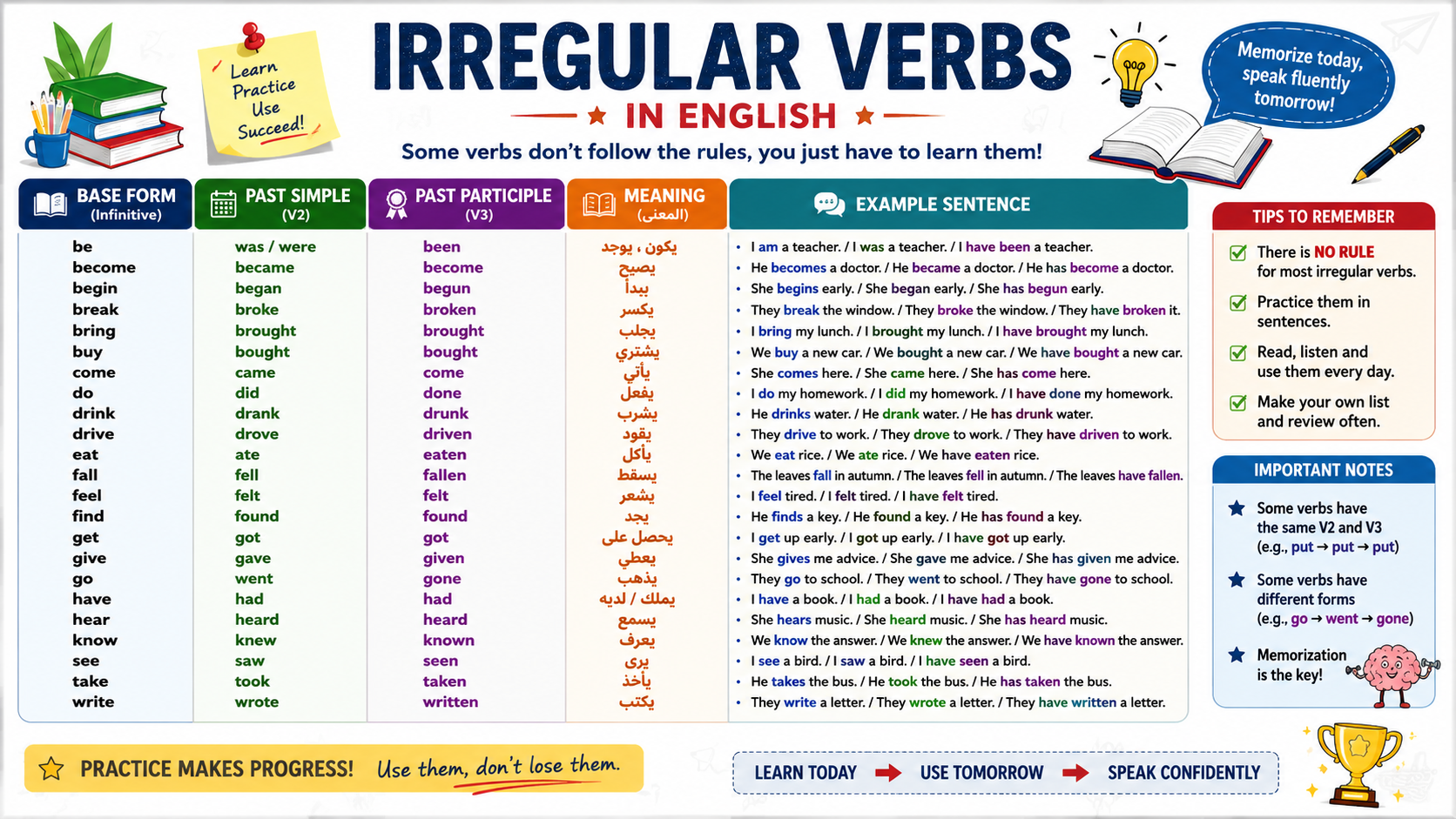
Irregular verbs are one of the most important parts of learning English because they are used frequently in everyday conversations, writing, and reading. Unlike regular verbs, irregular verbs do not follow the common rule of adding -ed to form the past tense and past participle, which makes them more challenging for many learners.
To help learners master these essential verbs, we have created a complete collection of the most common English irregular verbs with their different forms, including the base form, past simple, and past participle. The tool also provides example sentences to show how each verb is used in real situations, making it easier to understand the meaning and remember the correct form.
This tool allows users to explore irregular verbs in different ways according to their learning style. You can display the verbs automatically, view them in an organized table, or browse them as a simple list. You can also hide and reveal words or sentences, making it useful for practice, self-testing, and improving your English grammar and vocabulary.
Irregular Verbs Sort Tool
English Vocabulary
Select at least one topic and one subtopic, choose a view and item count, then click Generate.
Choose a voice for text-to-speech. In slideshow mode you can turn automatic reading on or off.
English Vocabulary
| Base | Past | Past Participle | Phrase |
|---|---|---|---|
| Stand | Stood | Stood | He stood waiting for the bus. |
| Bear | Bore | Borne | He bore the heavy load. |
| Put | Put | Put | She put the groceries in the fridge. |
| Slide | Slid | Slid | The child slid down the snowy hill. |
| Deal | Dealt | Dealt | He dealt the cards to the players. |
| Tear | Tore | Torn | He accidentally tore the paper. |
| Steal | Stole | Stolen | Someone stole my bicycle yesterday. |
| Hold | Held | Held | She held the baby safely in her arms. |
| Know | Knew | Known | I knew the answer immediately. |
| Spin | Spun | Spun | The dancer spun around quickly. |
| Fall | Fell | Fallen | The apple fell from the tree. |
| Forgive | Forgave | Forgiven | She forgave him for his mistake. |
| Make | Made | Made | I made a mistake on the test. |
| Write | Wrote | Written | I wrote a letter to my friend. |
| Teach | Taught | Taught | She taught me how to play chess. |
| Catch | Caught | Caught | She caught the ball with one hand. |
| Stick | Stuck | Stuck | The stamp stuck to the envelope. |
| Beat | Beat | Beaten | My heart beat faster. |
| Sit | Sat | Sat | We sat on the bench in the park. |
| Shine | Shone | Shone | The stars shone brightly in the sky. |
How to Learn and Remember English Irregular Verbs Effectively
Learning irregular verbs requires regular practice because there is no single rule that applies to all of them. The best approach is to start with the most common verbs used in daily English, such as be, have, do, go, get, make, take, and see, and gradually add more verbs as your knowledge improves.
Instead of memorizing a long list without context, try learning each verb with an example sentence. Understanding how a verb is used in real communication helps your brain remember it more easily. Reading, listening, and creating your own sentences using irregular verbs will make your learning process faster and more effective.
Reviewing irregular verbs regularly is essential for long-term memory. Use this tool to test yourself, hide the answers, and try to remember the correct forms before revealing them. With consistent practice, irregular verbs will become familiar, and you will use them naturally when speaking and writing in English.
- Log in to post comments