

This article provides a comprehensive, all-in-one guide to English modal verbs (can, could, may, might, must, shall, should, will, would), designed for learners at levels A1 to B1 who want to speak with confidence and precision.
The essential idea you must understand is that modal verbs are "helper" verbs that express possibility, ability, permission, obligation, necessity, and prediction. They never change form and are always followed by the base form of the main verb.
You will discover why the incorrect She can to swim. becomes the correct She can swim., and how mastering just nine modal verbs can dramatically improve your English fluency.
The key question to keep in mind is: What is the speaker's attitude or intention — ability, possibility, permission, obligation, or prediction?
The main rule to remember is: Modal verbs NEVER change form (no -s, -ed, or -ing) and are ALWAYS followed by the base form (bare infinitive) of the main verb.
By the end of this lesson, you will be able to use all nine modal verbs correctly in a variety of contexts, from everyday conversations to formal writing.
What Are Modal Verbs?
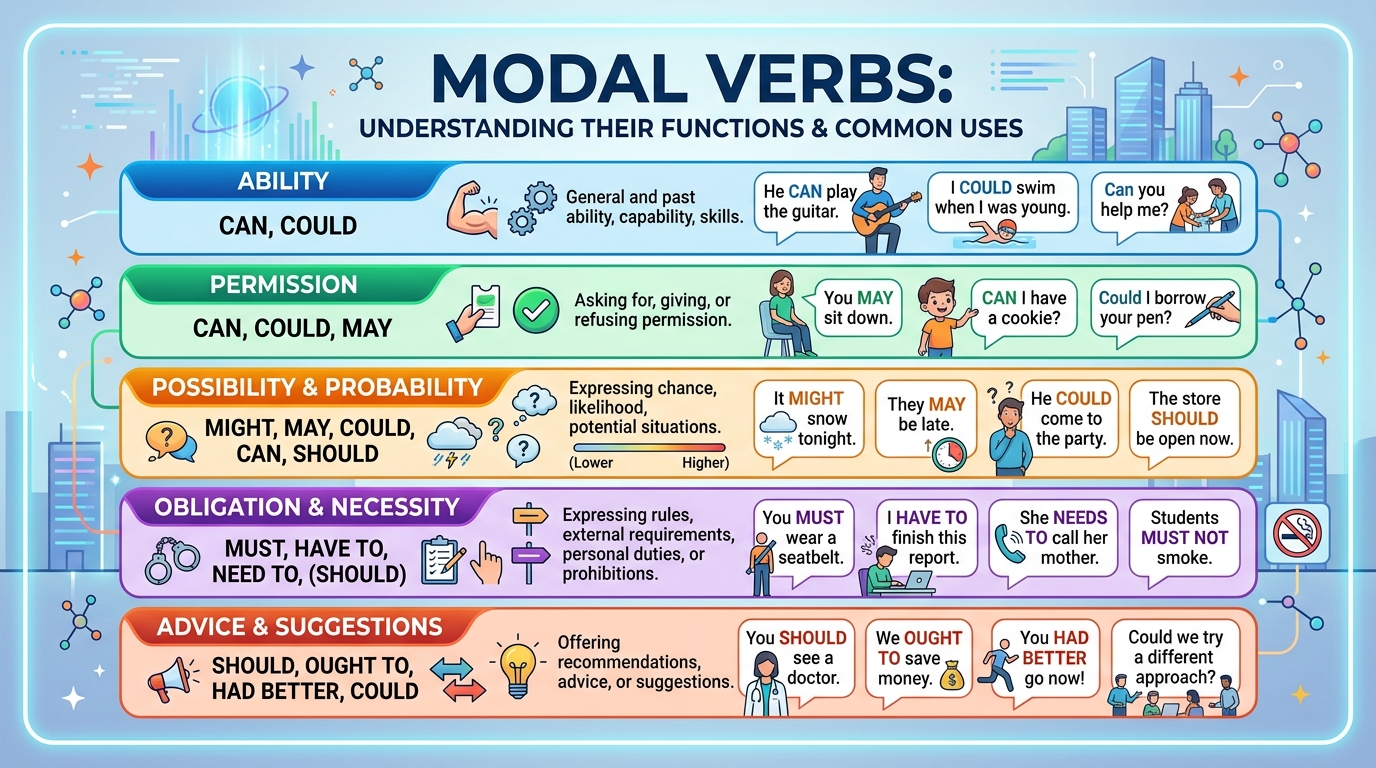
The Nine English Modal Verbs
Modal verbs are special auxiliary (helping) verbs that express attitude, mood, or intention toward an action. They don't describe actions themselves — they describe how likely, necessary, possible, or permitted an action is.
| Modal Verb | Core Meaning | Example |
|---|---|---|
| can | ability, possibility, permission | I can swim. |
| could | past ability, polite request, possibility | I could swim when I was 5. |
| may | formal permission, possibility | You may leave early. |
| might | possibility (less certain) | It might rain today. |
| must | strong obligation, necessity, certainty | You must wear a seatbelt. |
| shall | formal suggestions, future (with I/we) | I shall call you tomorrow. |
| should | advice, recommendation, expectation | You should see a doctor. |
| will | prediction, promise, willingness | I will help you. |
| would | polite request, hypothetical situation, past habits | Would you like some tea? |
The Golden Rule: Modal Verbs NEVER Change
- ✅ She can swim. (NOT: She cans swim.)
- ✅ He could help. (NOT: He coulded help.)
- ✅ They must go. (NOT: They musted go.)
- ✅ You should try. (NOT: You shoulding try.)
The Key Question: What's the Speaker's Attitude?
To choose the correct modal verb, ask yourself:
💪 Ability
can / could
"I can speak Spanish."
❓ Possibility
may / might / could
"It might rain."
⚠️ Obligation
must / should
"You must study."
🔮 Prediction
will / shall
"It will snow."
The Complete Rules of Modal Verbs
Rule 1: Ability — Can & Could
Can expresses present ability — what someone is able to do now. Could expresses past ability or a polite request.
✅ Can (Present Ability)
- I can speak three languages.
- She can run very fast.
- We can help you.
✅ Could (Past Ability / Polite)
- I could swim when I was 5.
- She could read before she started school.
- Could you help me, please?
- It can be very cold here in winter. (general possibility)
- It could snow tomorrow. (specific possibility)
Rule 2: Permission — Can, Could, & May
Can is informal permission for everyday situations. Could is a more polite request. May is formal permission, often used in official contexts.
| Modal | Level of Formality | Example |
|---|---|---|
| Can | Informal / Casual | "Can I use your phone?" |
| Could | Polite / Slightly Formal | "Could I borrow your pen?" |
| May | Very Formal / Official | "May I come in, sir?" |
Rule 3: Possibility — May, Might, & Could
These three modal verbs express different levels of certainty about a possible event.
| Modal | Level of Certainty | Example |
|---|---|---|
| May | 50-60% certain | "It may rain later." |
| Might | 30-50% certain (less sure) | "It might rain later." |
| Could | Purely possible | "It could rain, but I'm not sure." |
Rule 4: Obligation & Necessity — Must & Should
Must expresses strong obligation — something that is necessary or required. Should expresses advice or recommendation — something that is a good idea but not required.
✅ Must (Strong Obligation)
- You must wear a seatbelt.
- I must finish this report.
- Students must arrive on time.
✅ Should (Advice / Recommendation)
- You should eat more vegetables.
- She should apologize to him.
- We should leave early.
Rule 5: Prediction & Future — Will & Shall
Will is used for predictions, promises, and willingness. Shall is mostly used with "I" and "we" for formal promises or suggestions (more common in British English).
✅ Will
- It will rain tomorrow. (prediction)
- I will help you. (promise)
- I will open the door. (willingness)
✅ Shall
- I shall return soon. (formal promise)
- Shall we go for a walk? (suggestion)
- We shall overcome. (formal statement)
Rule 6: Polite Requests — Would, Could, Can
Would is the most polite form. Could is also polite. Can is more casual.
| Modal | Level of Politeness | Example |
|---|---|---|
| Would | Very polite / Formal | "Would you pass me the salt?" |
| Could | Polite / Standard | "Could you help me?" |
| Can | Casual / Informal | "Can you help me?" |
Examples with Deep Explanation
Example 1: "Can" — Present Ability
Meaning: She has the ability to speak four languages. This is a present, general ability.
Why it works: "Can" expresses ability in the present. It is followed by the base verb "speak" (not "speaks").
Key question: What is the speaker's attitude? → Ability → So we use "can."
Example 2: "Could" — Past Ability
Meaning: I had the ability to run fast in the past, but I may not be able to do it now.
Why it works: "Could" expresses past ability. It is followed by the base verb "run."
Example 3: "May" — Formal Permission
Meaning: The speaker is politely asking for permission to leave early.
Why it works: "May" is a formal way to ask for permission. It is followed by the base verb "leave."
Compare: "Can I leave early?" is casual. "May I leave early?" is more formal and respectful.
Example 4: "Might" — Less Certain Possibility
Meaning: There is a possibility (30-50% chance) that we will go to the beach. The speaker is not sure.
Why it works: "Might" expresses a less certain possibility. It is followed by the base verb "go."
Compare: "We may go" = 50-60% sure. "We might go" = 30-50% sure.
Example 5: "Must" — Strong Obligation
Meaning: It is required/necessary to wear a helmet. There is a strong rule or obligation.
Why it works: "Must" expresses strong obligation. It is followed by the base verb "wear."
Compare: "You should wear a helmet" = advice (optional). "You must wear a helmet" = requirement (not optional).
Example 6: "Should" — Advice
Meaning: This is a recommendation. Drinking more water is a good idea, but not required.
Why it works: "Should" expresses advice or recommendation. It is followed by the base verb "drink."
Example 7: "Will" — Prediction
Meaning: The speaker is predicting that tomorrow will be sunny. This is a forecast.
Why it works: "Will" expresses a future prediction. It is followed by the base verb "be."
Example 8: "Would" — Polite Request
Meaning: This is a very polite request asking someone to close the window.
Why it works: "Would" is the most polite way to ask for something. It is followed by "you" and then the base verb "mind."
Compare: "Can you close the window?" (casual) vs "Would you close the window?" (polite).
Common Mistakes & Logical Corrections
Mistake 1: Adding "to" After a Modal
Why Does It Change?
Modal verbs are always followed by the base form of the verb, NOT the infinitive with "to."
Remember: Modal + Base Verb (no "to").
Mistake 2: Adding "-s" to Modals with Third Person
Why Does It Change?
Modal verbs never change form. There is no "-s," "-ed," or "-ing" with modals.
Remember: Modals are the same for all subjects (I, you, he, she, it, we, they).
Mistake 3: Using "Mustn't" Confusion
Why Does It Change?
"Mustn't" means "it is forbidden" or "it is not allowed." It is followed by the base form of the verb, NOT "to" + verb.
Remember: "Mustn't" = "must not" = strong prohibition.
Mistake 4: Confusing "Must" and "Have To"
Why Does It Change?
"Must" is a modal verb, so it takes the base form of the verb. "Have to" is NOT a modal — it's a phrase that works like a modal but can change form.
Remember: "Must" + base verb. "Have to" + base verb (but "have" changes form: has to, had to).
Mistake 5: Using "Shall" in Modern English Incorrectly
Why Does It Change?
In modern English, "shall" is rarely used except with "I" and "we" in very formal contexts. "Will" is used for all subjects in most situations.
Remember: Use "will" for predictions with all subjects. "Shall" is mostly used with "I" and "we" in formal contexts.
Practice Exercises
Task 1: Choose the Correct Modal
Fill in the blanks with the correct modal verb (can, could, may, might, must, should, will, would):
- 1. I ______ swim when I was six.
- 2. You ______ finish your homework before you go out.
- 3. ______ I use your phone, please?
- 4. It ______ rain tomorrow, so bring an umbrella.
- 5. You ______ drink more water. It's good for you.
Task 2: Correct the Mistakes
Each sentence has one mistake. Find it and correct it:
- 1. She cans speak French fluently.
- 2. You must to wear a uniform.
- 3. They shall arrive by 5 PM. (change to modern English)
- 4. Could you to help me with this?
- 5. He shoulds study more.
Task 3: Write Sentences Using Modals
Write one sentence for each of the following situations:
- 1. Express ability (present)
- 2. Express polite permission (formal)
- 3. Express strong obligation
- 4. Express advice
- 5. Express a prediction
- 6. Express a polite request
Task 4: Modal Verb Story
Write a short paragraph (5-7 sentences) about your plans for next week. Use at least 5 different modal verbs.
Quick Quiz
Quiz 1: The Key Question
What is the key question you should ask yourself when choosing a modal verb?
Answer
Quiz 2: Choose the Correct Modal
Complete the sentence: "You ______ eat more vegetables."
Answer
Why? This is advice or a recommendation. "Should" is the correct choice.
Quiz 3: The Golden Rule
What is the golden rule about modal verbs and form changes?
Answer
Quiz 4: Find the Mistake
What is wrong with: "She can to speak three languages."
Answer
Why? Modal verbs are followed by the base form of the verb, NOT the infinitive with "to."
Quiz 5: Write Your Own Sentence
Write a sentence using a modal verb to express strong obligation.
Model Answer
Analysis: "Must" expresses strong obligation or requirement.
Final Review: Master Modal Verbs
To complete your journey with modal verbs, review these key points and use this checklist to ensure you've mastered everything.
💪 Can
Present ability
"I can swim."
⏳ Could
Past ability / Polite
"I could help."
✅ May
Formal permission
"May I come in?"
❓ Might
Less certain possibility
"It might rain."
⚠️ Must
Strong obligation
"You must go."
📖 Shall
Formal (I/we)
"I shall return."
💡 Should
Advice / Recommendation
"You should try."
🔮 Will
Prediction / Promise
"It will snow."
🙏 Would
Polite request
"Would you help?"
Ask the key question: What is the speaker's attitude — ability, possibility, permission, obligation, or prediction?
Ability → can/could | Possibility → may/might/could | Permission → can/may/could
Obligation → must/should | Prediction → will/shallRemember the golden rule: Modal verbs NEVER change form. They are ALWAYS followed by the base form of the main verb.
✅ can swim ❌ can swims / can to swimPractice using all nine modals: The more you use them, the more natural they become. Try to use at least one modal verb in every conversation.
can • could • may • might • must • shall • should • will • wouldCompare your sentences with correct models: Before finishing, compare your sentences with the examples in this article to catch any errors.
Compare → Correct → Confirm
📌 Quick Summary: Modal Verbs
💪 Ability
❓ Possibility
⚠️ Obligation
🔮 Prediction
🙏 Polite Request
🔑 Remember: Modal verbs NEVER change form. Modal + Base Verb (no "to"). What's your attitude — ability, possibility, permission, obligation, or prediction?
- Log in to post comments